Maya Warns the Queen of the Hornet Attack
The Adventures of Maya the BeeMaya’s warning to Queen Helen VIII is the turning point that gives Bee-city (the hive) time to prepare for the Hornets’ dawn attack. Returning from the Hornet fortress, Maya risks punishment to bring news of the invasion; the Queen answers not with retribution but with immediate action and forgiveness. The warning thus joins two reversals: the fugitive becomes the messenger on whom the community depends, and a threatened city turns alarm into organized defense.
The Return Before Dawn
Maya begins the chapter exhausted and alone, with little strength left after her escape from the Hornet fortress. In the dim dawn she flies toward the woods, hoping to find temporary shelter in case the Hornet who let her go changes his mind and pursues her. Cold, dew, and the heavy stillness make the journey harder. At first, she cannot identify a clear route or see how she might reach her people in time. She fears that she will fail to help them, and thinks of the chance to make amends for deserting them slipping away.
An instinct she associates with homesickness guides her onward. The grey domes of the castle park’s lindens give her a landmark, and the fog-covered meadows recall the Flower sprites, whose brief lives had encouraged her before. That recollection restores her confidence: she is willing to face the possibility that her people will reject or punish her if the Bees can be spared the coming danger. The purpose of her return is therefore not to secure her own welcome, but to warn the community even at personal cost.
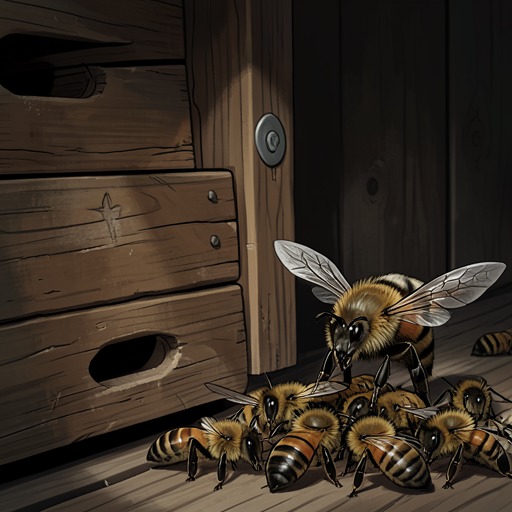
At the long stone wall, she recognizes the silver-fir that shelters Bee-city (the hive) from the west wind and sees its red, blue, and green entrances. She flies to the red entrance, the route to her people and Queen Helen VIII. Two sentinels stop her on the flying-board. Because Bees may not force their way into another city without the Queen’s permission, they initially treat her entry as a capital offense and threaten her. Maya is too breathless to explain herself until she gives the password that identifies her as one of their own. Even then, the sentinels hesitate: the Queen may not be awakened before sunrise. Maya insists that she must see the Queen at once because the city is in terrible danger.
The Warning and the Queen’s Response
News of the confrontation travels quickly through the hive. Wax-generators are already awake, and curious Bees peer from openings as two officers take their places beside the doorway in anticipation of the Queen. Queen Helen VIII arrives without her court, accompanied only by her aide and two ladies-in-waiting. Seeing Maya’s condition, she softens her initially severe expression and asks whether Maya has brought an important message.
Maya can manage only the warning that the Hornets are coming. Once she can speak more fully, she explains that she has just escaped from the Hornet fortress and that the last information she heard there was a plan to attack and plunder the Bees’ country at dawn. She also admits her earlier failure to respect her duties and asks forgiveness, promising to explain her conduct later. Her message does not erase her desertion, but it makes the immediate stakes unmistakable: the enemy has a plan, the attack is imminent, and the Queen has little time to act.
The warning throws the Queen’s attendants and officers into alarm. Queen Helen VIII, however, remains composed. She summons the officers and gives rapid orders, setting a strict deadline for their execution. Their speed shows that the hive’s response is not merely a burst of panic: command is clear, and the officers are ready to carry it out at once. Maya watches the Queen’s steadiness restore confidence even as the news spreads.
The Queen thanks Maya for saving the community and declares that her warning outweighs her previous conduct. When Maya says she would gladly die for the Queen, the Queen answers that the thousands who live in the city would likewise sacrifice themselves for her and the country. She then kisses Maya on the forehead and sends the ladies-in-waiting to care for her. Forgiveness here is both personal and civic: Maya is welcomed back, while her act is recognized as service to the whole community.
Mobilization and Defense
Maya is led away to rest as signals sound and officials gather around the royal chambers. The approaching army is announced by the distant drone of the soldiers. The next chapter shows what the warning has set in motion: the Bees mobilize rapidly, with each soldier taking up an assigned duty. Scouts report that the Hornets are drawing near, while the hive’s excitement remains organized rather than confused.
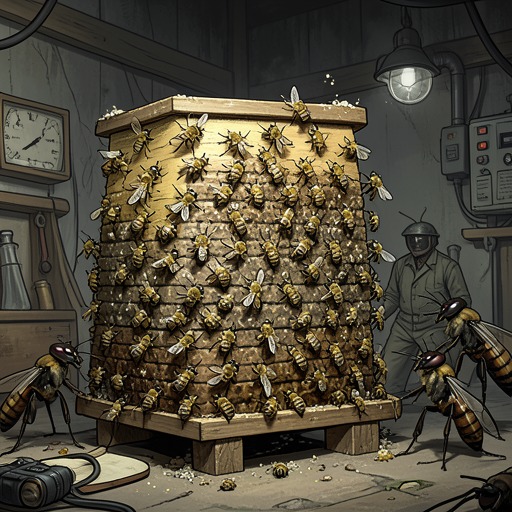
At the entrance, soldiers form three closed ranks. In feverish silence, wax-generators narrow the opening, raising two thick partitions that will delay the Hornets and reducing the entrance to almost half its former size. Queen Helen VIII takes an elevated position from which she can survey the battle, while her aides carry out their tasks. These preparations reflect the advantage Maya’s early warning has provided: the Bees can choose their defensive arrangement and prepare the entrance before the enemy reaches it.
When the Queen gives the order to defend the realm, the battle begins. A young officer rushes forward too early and dies in the opening clash; his courage intensifies the Bees’ willingness to fight. The Hornets’ size and armor make them formidable, but the Queen’s defensive plan uses fresh ranks to meet intruders who press farther into the hive. The struggle is costly, and the Hornets’ stings inflict severe losses. Yet the invaders’ strength does not remain decisive: their sting loses its force over time, while the Bees, grieving for their dead and fighting as a united force, gradually gain the advantage. The outside Hornets eventually receive no answer from the fighters within, and their leader withdraws the remaining combatants; their numbers have fallen by half.
Collective Meaning and Consequences
The warning makes Maya’s return the hinge between solitary flight and collective action. At the entrance she is first treated as a threat because she arrives outside the ordinary rules of permission; the password establishes her identity, but only her urgent message explains why she must be admitted at once. Her transformation from deserter to defender is made concrete through the Queen’s response: forgiveness follows a useful act, and that act gives the community time to prepare.
The battle also gives political meaning to the Queen’s words about sacrifice. The Bees’ resistance depends not simply on individual bravery but on coordination: sentinels guard the entrance, messengers report the enemy’s approach, wax-generators fortify the passage, soldiers hold their ranks, and officers respond to command. An older Hornet recognizes this contrast after the fighting, describing the Bees as a unified nation whose members serve the common good without turning traitor. The warning therefore reveals the strength that the Hornets had underestimated. Maya brings the crucial knowledge, but the defense succeeds through the community’s capacity to act together.